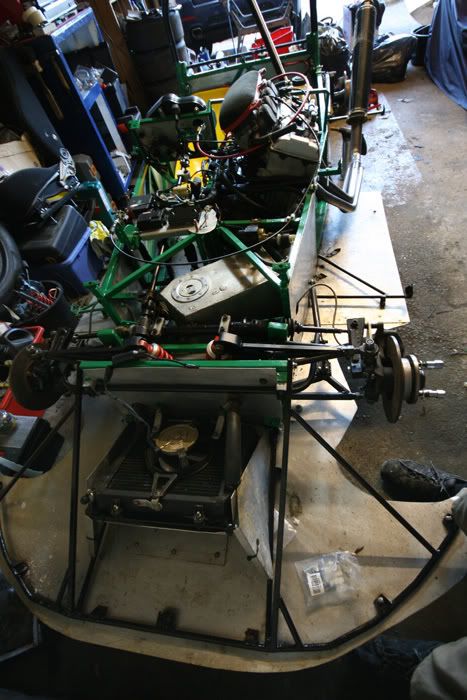
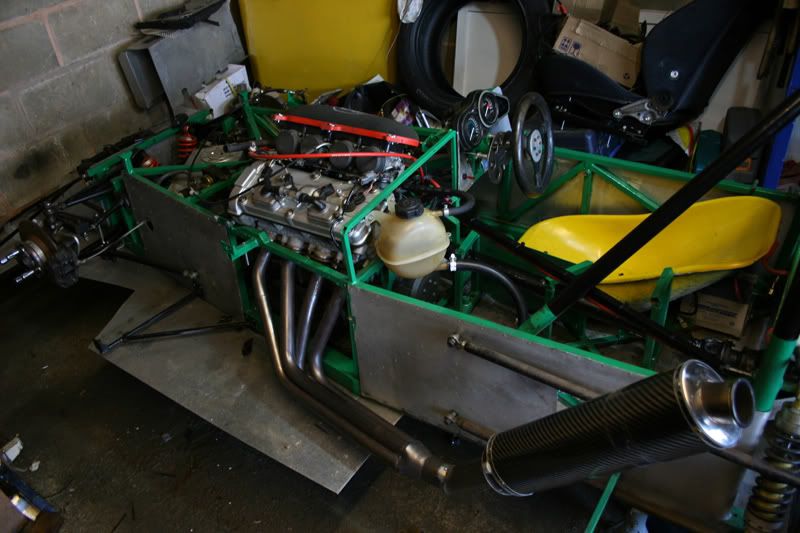
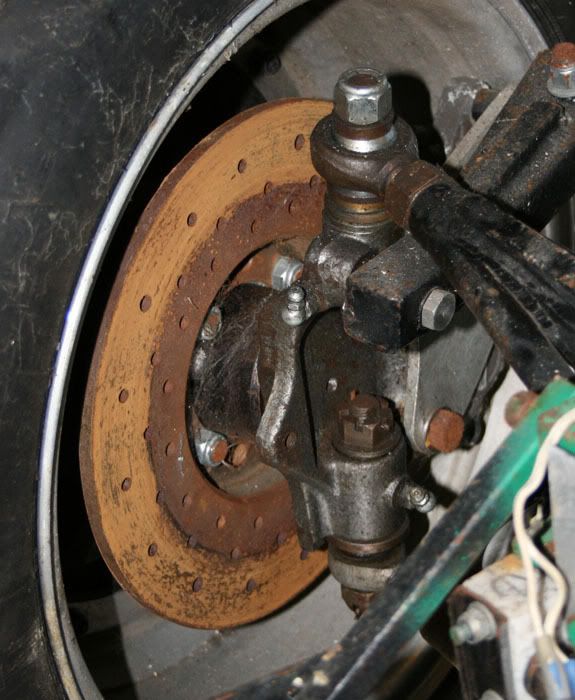
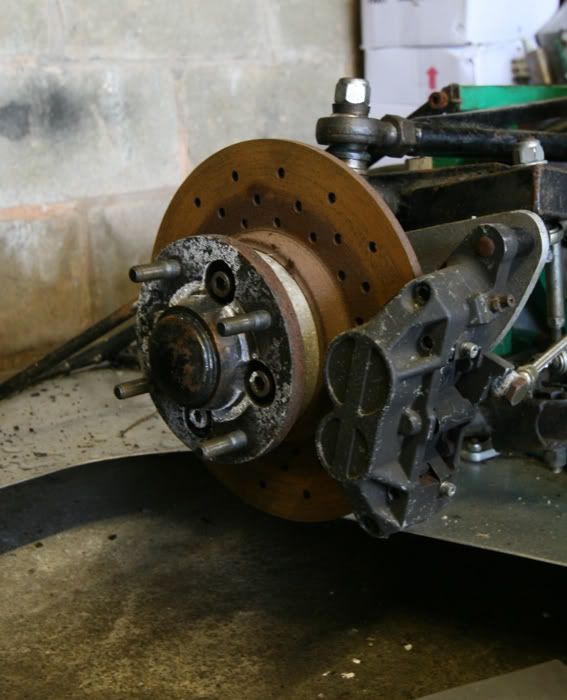

Seen a few threads on this where folk have said they'll give it a go, but the thread usually peters out without a definitive 'yay, or
'nay'...
So, has anyone done it, and if so, how did you get on???
Also, I'm guessing the 'worry' has more to do with the (lack of) disc thickness as most sports-bikes tend to run a 5mm rotor???
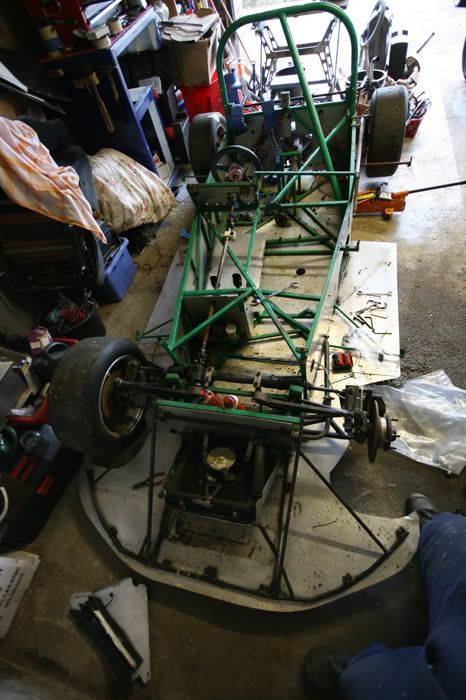
I had bike calipers on my little race car with custom made disks.. they were 8mm IIRC
Lack of thermal capacity is the problem. The disc needs to be able to absorb the kinetic energy of the car into thermal energy in the metal rotor
which then takes some time to co0l down.
A car has considerably more kinetic energy than a bike!
^ was thinking that myself
the heat generated in a car will be much more than a bike, but there will be twice as many discs as on a bike...
how much does a bike weigh, and how much does a 7 weigh?
if the 7 is less than double the weight of a bike then might be ok
if its more than double the weight of a bike, forget it
in any case, i wouldn't trust it
That's pretty much what I thought too, however, I've seen plenty of Se7ens with 10mm x 232mm discs which stop perfectly adequately... an R1
has a 5mm x 310mm disc, so has more area.
Is this a factor???
i do recall seeing a busa powered mini with bike brakes but dont recall the name of the chap.
a larger disc surface area will aid cooling but being thinner increases the risk of warping.
[Edited on 17/11/09 by ashg]
quote:
Originally posted by blakep82
^ was thinking that myself
the heat generated in a car will be much more than a bike, but there will be twice as many discs as on a bike...
how much does a bike weigh, and how much does a 7 weigh?
if the 7 is less than double the weight of a bike then might be ok
if its more than double the weight of a bike, forget it
in any case, i wouldn't trust it
quote:
Originally posted by blakep82
^ was thinking that myself
the heat generated in a car will be much more than a bike, but there will be twice as many discs as on a bike...
how much does a bike weigh, and how much does a 7 weigh?
if the 7 is less than double the weight of a bike then might be ok
if its more than double the weight of a bike, forget it
in any case, i wouldn't trust it
how about just using them on the rear?? It would save a good bit of unsprung weight
Have a look at the car grass track world
a lot of people use bike brakes my mate used them on his race car
Jacko
quote:
Originally posted by Miks15
quote:
Originally posted by blakep82
^ was thinking that myself
the heat generated in a car will be much more than a bike, but there will be twice as many discs as on a bike...
how much does a bike weigh, and how much does a 7 weigh?
if the 7 is less than double the weight of a bike then might be ok
if its more than double the weight of a bike, forget it
in any case, i wouldn't trust it
Not quite, most sports bikes will have two discs on the front

quote:
Originally posted by scootz
That's pretty much what I thought too, however, I've seen plenty of Se7ens with 10mm x 232mm discs which stop perfectly adequately... an R1 has a 5mm x 310mm disc, so has more area.
Is this a factor???
Make sure whatever you do stands up to technical scrutiny.
If its not engineeringly sound for whatever reason, and you are involved in an accident, the insurance Co will reduce your payout or not pay at
all.
OK it may have passed a SAV/IVA, but is it worth the risk?
The weight saved is only really relevant if you are building a race car. These cars are for the Road, where the general public idiots abound.
Is it really worth taking ANY risk with your car, your life or someone elses?
Do it Right, Do Properly, and right first time.
You CANNOT be TOO SAFE.

I would also think the amount of force applied to the brakes would be considerably higher than what they would receive from a bike. I know 7s don't weight much, but when the car dives under hard braking the weight transfer has got to be much higher than what bike brakes are engineered for. I would imagine that the front rotors would go away rather quickly.....
My 2 pence:
On a bike the rotors are exposed to full airflow over them!
On a car they are hidden in the weel so less airflow over them!
I can see absolutely no reason why they would not be perfectly adequate for road use & I would expect them to be fine for anything but the most
extreme track use. (this is of course assuming a light, sub 500kg car & that it does not have to carry 2 x 20 stone occupants).
The only time I think it likely you'd run into trouble is where you were on a circuit with several short to mid length straights with heavy
braking into tight turns & a car with big power that would generate a lot of kinetic energy very quickly & no long straights or long
accelerating turns to cool the discs off.
I have seen a disc completely "wrung off" its centre, but it had been worn by metal to metal contact near the centre to only around 2 - 3mm
thick!
Surprise, looks like your not going to get a yes or no!.. Personally I'd stick with the known car brakes.. If it was for track only I might be
tempted to try it and see..
Like said if insurance company finds out you are using bike brakes, they could indeed start to argue that car brakes would have been more suitable..
If we can't make our minds up then I expect an insurance based one would say bike brakes were in-sufficient (even if this is not the case!)...
Dan
Dan
Kinetic energy is 0.5 x mass x velocity squared
An R1 can do 190mph, and in doing an emergency stop from that would put 1.8 times as much energy into the brakes as stopping a 7 that is twice the
weight from 100mph... The twice as heavy 7 has to do 135mph to use the same energy to stop.
it's my winter project, got the calipers of a fz6r, 2 piston opposed, and the front disks to match there going on the rear of the car, keeping the car brakes on the front piston area is almost the same so i'm hoping blanace bar will be enough to take out the difference just waiting on my brother making up the caliper brackets before i can work out the dism mounting
Hmmm.... some interesting thoughts there - thanks all! Keep 'em coming!
The 'technical scrutiny' aspect mentioned earlier is the one that's got me thinking the most... not so much from the insurance point of
view, but more in relation to being involved in a serious accident where someone else gets injured and my choice of brakes was to blame. I'd
have to be sure that the concept was sound for a road going car and I guess I'm never going to have that reassurance without there having been
some kind of study into the subject!
quote:
Originally posted by ed1801
Kinetic energy is 0.5 x mass x velocity squared
An R1 can do 190mph, and in doing an emergency stop from that would put 1.8 times as much energy into the brakes as stopping a 7 that is twice the weight from 100mph... The twice as heavy 7 has to do 135mph to use the same energy to stop.
I wouldn't get too hung up on the "bike brakes" being "bike brakes". Tokico 6 pots are 6 pot calipers just designed to fit a
smaller disc.
One thing to watch is the price of the pads. They can be hugely expensive for what is a very small pad!
Not got a problem with the calipers... I'm sure 4 x bike six-pots will do the business. It's more the necessary disc thickness (5mm).
You can always go for a thicker disc & have a bit machined off the pads if necessary, pads won't last long mileage wise, but how many miles a
year are you going to do?
Also I have to take issue with wind resistance supplying much of the stopping power in an emergency stop!!! At 190mph, if you take your hand off the
throttle you'll slow down fairly quickly to about 100mph, but it will still have taken 3 football pitches, that's hardly an emergency
stop!!!
5mm on the rear works fine including heavy track use. Personally i would worry about using 5mm on the front, with anything much over 350kg, 8mm would
be a safer bet.
Al
Just another thought, if you're really concerned about the possibility of a disc fracturing, I'm sure someone on here can work out the shear
strength of a 5mm disc - personally I'll be gobsmacked if it's not at least 3 times what you could ever actually put thro' the disc in
braking terms!
I could have done it for you at one time, but my college days are a few years ago now!
If the callipers are two part, can you not just put an alloy spacer between the halves.... some car brakes come like that as standard!!
That way you can use the bike calipers with a slightly thicker disk??!?? Would make it easier to fit a handbrake mech as well if there is a little
more space to play with!
My effort here
9 mm discs, which I plan to use with early golf GTI rear calipers
Cheers
Fred W B
[Edited on 17/11/09 by Fred W B]
I don't think fracturing would be such a problem, more likely to warp.
Al.
Originally posted by russbost
Just another thought, if you're really concerned about the possibility of a disc fracturing, I'm sure someone on here can work out the shear
strength of a 5mm disc - personally I'll be gobsmacked if it's not at least 3 times what you could ever actually put thro' the disc in
braking terms!
I could have done it for you at one time, but my college days are a few years ago now!
quote:
Originally posted by jacko
Have a look at the car grass track world
a lot of people use bike brakes my mate used them on his race car
Jacko
quote:
Originally posted by ed1801
Kinetic energy is 0.5 x mass x velocity squared
An R1 can do 190mph, and in doing an emergency stop from that would put 1.8 times as much energy into the brakes as stopping a 7 that is twice the weight from 100mph... The twice as heavy 7 has to do 135mph to use the same energy to stop.
I think they would probably warp like a bugger. Decent sports discs are fully floating to reduce the chance of warpage. Bike discs can warp under
normal enthusiatic use let alone the extra few hundred kilos of a car. I remember back in the late 90's is being not exactly unusual on some
sports bikes.
On top of that, plenty of bike calipers are buggers for seizing and requiring new seals every few years (and that is with regular cleaning).
I think using bike calipers may well be a disaster waiting to happen. As mentioned, brakes are the thing that stops you going splat (and the person in
your way). Its something I would *really* not under engineer.
Certainly I wouldn't even try it on the road without some proper investigation from an enginering perspective. You can say "sod that its too
dangerous I think", but you can't do "yeah you can probably do that" then stack yourself into a tree as the brake fluid boils over
and the discs are juddering like its ABS.
You should have a look at a Pilbeam, that said, they are designed for about 60 seconds use at a time on a hillclimb!