
diffusers AGAIN
omega0684 - 17/4/09 at 09:59 PM
After my first post i thought that my question was a little miss understood,
i have spent the last three hours in the garage preparing the car for the shakespeare raceway tomorrow. the diffuser that my question was in reference
to was for my car, NOT THE BRAUN GP CAR!
Anyway here are some pictures
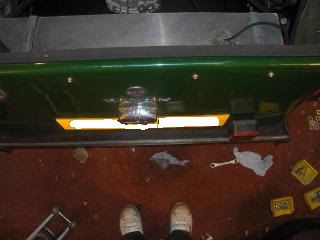
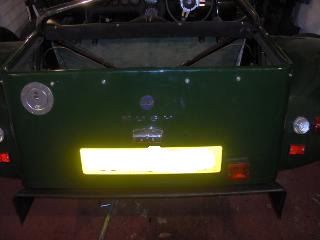
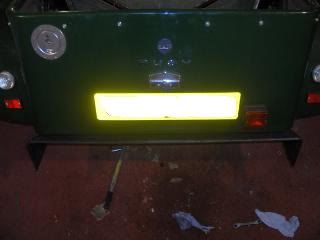
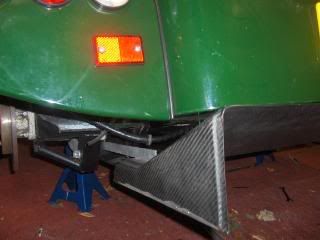
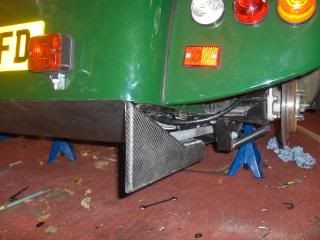
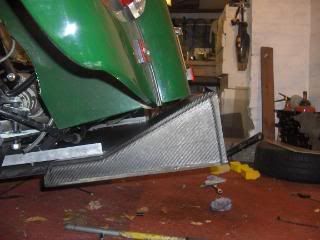
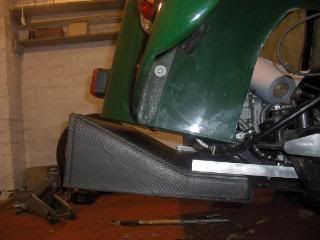
is anyone going tomorrow, would be nice to meet up and say hello.
Pdlewis - 17/4/09 at 10:02 PM
oooh nice is that some real carbon as well?
Should have a number plate next week so ill have to pop over and have a look
blakep82 - 17/4/09 at 10:04 PM
ah, see, but the F! regulations say you can't have bodywork above the diffuser...
 sorry
sorry
looks real good  reckon you've got it looking right, with the right amount out the back, but as i understand them, the whole underside of the
car needs to be completely flat to make it work. so EVERYTHING should be panelled, under the engine, tunnel, annt area and diff etc.
reckon you've got it looking right, with the right amount out the back, but as i understand them, the whole underside of the
car needs to be completely flat to make it work. so EVERYTHING should be panelled, under the engine, tunnel, annt area and diff etc.
i think if you don't flat bottom the car, you're essentially making a parachute
BenTyreman - 17/4/09 at 10:13 PM
The change in angle looks a bit abrupt. Did you design it yourself or buy it?
omega0684 - 17/4/09 at 10:13 PM
bought it, its one of the westfield ones, the pictures make it look more abrupt than it is
yes real carbon fibre!
[Edited on 17/4/09 by omega0684]
gingerprince - 17/4/09 at 11:11 PM
It doesn't appear to have the extra longitudonal fins that most diffusers seem to have. I thought it was these that made it work? i.e. it gives
the air a narrower passage to travel down, which accelerates it, thus lowering pressure and creating downforce.
BenTyreman - 17/4/09 at 11:18 PM
If the fins are planar then the area change of each passageway is the same as the area change of the diffuser, i.e. the flow accelerates the same.
The diffuser is increasing in volume the further back so surely the average flow is decelerating, not accelerating? The curvature of the diffuser
generates the downforce.
I thought the fins are to control spanwise flow.
greggors84 - 18/4/09 at 12:03 AM
The diffuser doesnt actually create downforce. Its the flat floor on the car that does it. As said as the flow comes out the diffuser it is actually
slowing down.
The point of it is to re introduce the fast moving air flow from underneath the car (that creates low pressure hence downforce) back in to the slower
moving flow around the car.
The fins (or turning veins) on the underside of the diffuser are there to help the air flow exit straighten up and exit straight out the back of the
car.
Edited to add...
Shakespear raceway is a drag strip right? If so then you want as little downforce as possible. In most cases downforce = drag.
[Edited on 18/4/2009 by greggors84]
BenTyreman - 18/4/09 at 01:01 AM
At the beginning of the diffuser Z-wise velocity = 0. At the end of the diffuser there is some Z-wise velocity due to the upwards curvature of the
diffuser.
Doesn't this lead to downforce, or is it balanced (or exceeded) by the increase in pressure under the diffuser due to the slowing of the air?
Edit: Having consulted Katz it seems that the initial curvature creates a suction peak, while the rest of the diffuser increases the pressure
above that of a flat floor (but still less than atmospheric).
Combined with a rear wing, a diffuser will out perform a flat floor for creating downforce.
[Edited on 18/4/09 by BenTyreman]
Rob Palin - 18/4/09 at 08:29 AM
There are two real functions of a diffuser on a car, the fundamental one being to gradually slow the air passing underneath the car down so that the
static pressure recovers to the level of the base pressure behind the car. Without this you get a kind of jet exiting the underfloor at the rear of
the car and this is a very high-loss process in energy terms and so you get much less flow under the car as its effective resistance is much higher.
The jet flow condition also lowers the base pressure (less air will be 'filling back up' the void behind the moving car as it displaces it)
so you get more drag.
The second function is to exploit the diffuser flow mechanism to generate a downforce. This comes in two parts - maximising the mass flow rate of air
through the gap between the floor of the car and the ground and maximising the amount by which you can turn the airstream upwards during the diffusing
process (pedantically, it isn't actually 'diffusing', but this is still the normal vernacular so it's ok).
The first of those two creates downforce through the widespread reduction in static pressure as the mass of air has to squeeze through the relatively
narrow gap under the car.
The second comes from local drops in static pressure where the air changes direction (the static pressure gradient is what provides the centripetal
acceleration that facilitates the turn).
The typical pressure distribution for a flat floor with a diffuser therefore has a big suction peak at the entrance as the flow turns to get in, then
a gradual rise along the flat bit of the floor, another suction peak at the apex of the diffuser and then as rapid a rise back to the base pressure
value as you can get away with.
The strakes are there to limit lateral flow to try and make the diffuser flow more 2-dimensional and therefore closer to a nice theoretical ideal with
maximum efficiency. If you want to crank up the angle of the diffuser a long way, however, to try and increase maximum downforce at a higher cost in
drag, then you need to cut down on the strakes and instead carefully manage the lateral flows to try and supply 'fresh' air to the regions
where the most work is being done. This applies equally to highly cambered wings or high angles of attack, too, and is why sometimes bigger endplates
don't mean better.
Jeez this is way too heavy for this early on a Saturday.  I'm going back to bed!
brianthemagical - 18/4/09 at 09:52 AM
On a lighter note, the diffuser in the pics doesn't like it'll do much, so performance wise it doesn't make too many odds how it's
fitted. It might be an idea to have a small gap or holes above the diffuser to aid air flow that might get trapped above the diffuser, and it can also
be used for cooling/air venting with a flat floor should you fit one.
BenTyreman - 18/4/09 at 11:09 AM
Anyone going to write "Build your own full-scale wind tunnel for £250"?
greggors84 - 18/4/09 at 12:50 PM
Cheers for that Rob. Helped me understand a few things. I had never really thought about the curvature providing downforce as the diffuser goes up. I
was just thinking more generally about the volume increasing hence the velocity slowing.
Am I right in thinking the diffuser is useless though without a decent flow feeding into it, which is why the need for a flat section from the front
to the rear.
Rob Palin - 19/4/09 at 09:42 AM
quote:
Originally posted by greggors84
Am I right in thinking the diffuser is useless though without a decent flow feeding into it, which is why the need for a flat section from the front
to the rear.
Absolutely, yes, if you want to generate much in the way of downforce then the floor does need to be as smooth as you can get it leading up to the
diffuser. When you're trying to turn the flow upward at the back you're effectively acting the air closest to the car surface it to run
'uphill', as it has to fight against the adverse pressure gradient from the bulk flow slowing down. The nicer you are to it beforehand, the
more energy it will have left to make the turn.
BUT (there had to be one, didn't there?) I've done some tests with diffusers on 7s in the wind tunnel and in practice it's not really
enough just to panel the floor as the narrow front / wide rear layout of a 7 means you get a lot of flow coming in from the sides of the main chassis.
That flow has normally been abused by the front wheels & suspension so it needs to be kept away from the 'fresh' air you want to work
hard in the diffuser by extending the diffuser endplates forwards up to the level of the scuttle.
That may or may not be very practical so it just means you have to compromise on the aggressiveness of the diffuser - making it longer (>500mm) and
shallower (<15degrees).
Hope this helps.