C10CoryM
|
| posted on 10/10/07 at 03:41 AM |

|
|
Rotating mass calculator?
Hey guys,
Was looking to figure out how much some heavier wheels affects the acceleration of a car. I have a calculation in one of my reference books, but
its pretty involved (includes entire driveline).
Does anyone have a simpler calculation, or online calculator for this?
Thanks,
Cory
"Our watchword evermore shall be: The Maple Leaf Forever!"
|
|
|
|
|
matt_claydon
|
| posted on 10/10/07 at 07:25 AM |
|
|
Problem is you need to know the moment of inertia of the wheel. ie, not just its mass but also how that mass is distributed. You could make a guess
based on the assumption that the wheel/tyre combination can be represented by an annulus of material at a radius probably about the same as that of
the rim.
[Edited on 10/10/07 by matt_claydon]
|
|
|
nathanharris1987
|
| posted on 10/10/07 at 10:22 AM |
|
|
Agreed;
Moment = force X perpendicular distance
matt how do you know this? I sense the physics force is strong in you!
|
|
|
Bob C
|
| posted on 10/10/07 at 11:34 AM |
|
|
Easiest to calculate energy (0.5 x M x V^2 for the car + 0.5 x I x w^2 for each rotating bit) at some abitrary speed (60mph works for most folk) &
look at the % change.
I think you'll find that flywheel rotational energy is more significant that wheel rotational energy, but it does depend what gear you're
in.
Also note that for flywheel inertia, either use engine revs instead of wheel revs, or multiply its calculated moment of inertia by the gear ratio
squared (don't forget the diff ratio is part of this)
Hope it works out for you...... ;^)
Bob
[Edited on 10/10/07 by Bob C]
|
|
|
matt_claydon
|
| posted on 10/10/07 at 11:47 AM |
|
|
quote:
Originally posted by nathanharris1987
matt how do you know this? I sense the physics force is strong in you!
4 Years of Engineering degree makes you quite familiar with these things 
|
|
|
nathanharris1987
|
| posted on 10/10/07 at 12:27 PM |
|
|
Ahhh great stuff! Im currently doing an HNC in civil Eng. Where did you do your degree?
|
|
|
matt_claydon
|
| posted on 10/10/07 at 12:28 PM |
|
|
A rough calculation with the assumption that the wheel's mass is concentrated at the rolling radius gives me that the effective mass as far as
acceleration is concerned is twice the real mass.
In reality this will not be the case as the mass is distributed between the hub and the road contact so the moment of inertia will be less than I have
assumed. A rough guess might be 1.6 times the actual mass.
This is liable to have errors though as it's too long since I did any maths! Will be in the right sort of area though.
In reply to above: Mechanical Engineering at Bristol. Finished 2 years ago and now working in vehicle engineering.
[Edited on 10/10/07 by matt_claydon]
|
|
|
chriscook
|
| posted on 10/10/07 at 06:18 PM |
|
|
quote:
Originally posted by matt_claydon
In reply to above: Mechanical Engineering at Bristol. Finished 2 years ago and now working in vehicle engineering.
Who in Bristol are you doing vehicle engineering for?
|
|
|
C10CoryM
|
| posted on 11/10/07 at 03:05 AM |
|
|
Thanks guys.
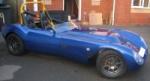
Ya, I knew that the further out the mass was affected things. For example, my locost has 15", 15lb wheels, and 23", 20lb tires so I
know most of the weight is in the outer few inches.
Basically, the reason I asked is because a friend put some heavier, lower profile wheels on his car and it VERY noticably slowed it down. I opt for
lighter wheels because of unsprung weight, but I was suprised at how much acceleration he lost. Ideally, Id like to calculate how the added rotating
mass would compare to adding ballast to the sprung weight. 1lb heavier tire= Xlbs of ballast sort of thing.
I will play around a bit and see what I get. Most likely the wrong answer 
Cheers.
"Our watchword evermore shall be: The Maple Leaf Forever!"
|
|
|