
Do the drive flanges need to be parallel
Trev Borg - 11/4/07 at 07:46 PM
The drive on my car seem to point the the sky.
Its a live axle with diff set to the drivers side.
I have tried to get the engine and gear box as square as possible, but this means that the drive plate angles are not parallel in one plane.
Does this matter?

should i shorten the upper trailing arm to alter the angle in the diff flange?
trikerneil - 11/4/07 at 08:54 PM
I would say yes they need to be parallel in both planes.
Possibly some help HERE
Chippy - 11/4/07 at 10:08 PM
The flanges definately need to be parallel to each other, without a doubt. Its OK for them not to be in line, as long as its not by too much. Both of
the UJ's should opperate at the same angle. So in answer to your question, yes, you need to adjust the lengths of your trailing arms. HTH Ray
Trev Borg - 11/4/07 at 11:15 PM
Thanks for the replies, as i thought really.
The kit was half built when i got it, and there is a few strange things with it.
I'm thinking the brackets on the axle must have been welded in the wrong place to make the diff point up over. We are only talking about a few
degrees, but, a few mm from the top trailing arm should cure it.
daviep - 12/4/07 at 05:51 AM
I stand to be corrected but as far as I know (or can find out) the flanges DO NOT need to be parrallel but joint angles must be the same in order to
cancel out speed differences between driver and driven yokes.
Have a look here to see it explanied better
If anybody can explain why they must be parallel please speak up.
britishtrident - 12/4/07 at 06:53 AM
They need to be close to parrallel or it will generate a cyclic variation in velocity eg vibration.
This means exactly the same as the joints being at equal but opposite angles.
bimbleuk - 12/4/07 at 08:23 AM
From that description I read it as they don't need to be inline or parallel but you do need more than one joint to counter the uneven cyclic
rotation between the driven and driving shafts/flanges.
The joint angles being in the same plane is probably the difficult bit to do in real life when your working in a confined space.
Having written that I presume it must be better to keep them as parallel as possible with a slight offset to even out the joint wear.
[Edited on 12/4/07 by bimbleuk]
Bob C - 12/4/07 at 09:05 AM
just a warning - it sounds as though you're planning to shorten the upper trailing arms. Be warned - the trailing arms need to be equal length
and parallel or else you are twisting the axle in roll.
You really need to shift the chassis mounts for the trailing arms.
Bob
MikeRJ - 12/4/07 at 09:33 AM
quote:
Originally posted by daviep
I stand to be corrected but as far as I know (or can find out) the flanges DO NOT need to be parrallel but joint angles must be the same in order to
cancel out speed differences between driver and driven yokes.
Have a look here to see it explanied better
If anybody can explain why they must be parallel please speak up.
I'm pretty sure this is correct, just from my own experiences. If the angles of the two joints are equal, or equal and opposite and are in the
same plane then the cyclic speed variations will be compensated for.
e.g.
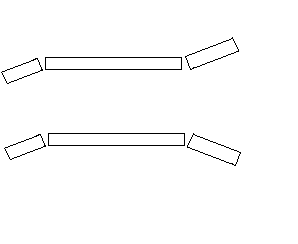
britishtrident - 12/4/07 at 10:49 AM
In the upper example the cyclic speed variation due to each joint is 180 degrees out of phase eg it cancels out.
In the lower example the speed variation will be in phase eg the effects of each joint will be added to give twice the vibration.
[Edited on 12/4/07 by britishtrident]
MikeRJ - 12/4/07 at 11:47 AM
quote:
Originally posted by britishtrident
In the lower example the speed variation will be in phase eg the effects of each joint will be added to give twice the vibration.
Just from "playing" with technical lego etc. when I was younger, I could easily feel that the upper example canceled the speed variation out
in the same way as the lower one. This is confirmed by the link that daviep posted and also
here.
I think the only way to get twice the cyclic speed variation is if the two joint are angled in planes 90 degrees apart.
britishtrident - 12/4/07 at 02:16 PM
If it did it would make CV joints obsolete.
Back in days of leaf springs wedges were often fitted between the leaf spring and the axle to correct this type of problem.
JoelP - 12/4/07 at 06:04 PM
a uj pulses twice per revolution (a faster burst on the output each time the input joint is flat in the same plane as the bend, and its obviously flat
twice per revolution), in the lower example you simply line up alternate pulses.
As an extreme example, you could bend each joint to the full 90 degrees so that the 3 pieces of tube cover 3 sides of a square. Then put a pair of
engaged cogs on the input and output to prove they are rotating at the same speed, and then rotate the device manually. First you would turn either
cog through 180 degrees, then it stops and the middle part is rotated 180 degreed (90 to catch up and 90 to put it in front) then another 180 on both
cogs. This also neatly demonstrates the most extreme pulsing possible - full start/stop.
This is made impossible by the fact that car u'js dont bend to 90 degrees, or infact anywhere near it, but lego ones do and you could make big
ones that did too.
[Edited on 12/4/07 by JoelP]
Trev Borg - 12/4/07 at 07:23 PM
So basically, the double uj on the shaft and the slider in the end of the gearbox can eliminate the vibration, provided the angles are somewhere near
?
Or am I wrong?
people seem to have different opinons on this one.
So what has everyone else done.
Should my soloution be to alter the brackets on the rear axle to the diff sit better ?
Trev Borg - 12/4/07 at 07:29 PM
http://www.pirate4x4.com/tech/billavista/PDFs/Federal_Mogul_how_to_measure_driveshaft%20angles.pdf
having read this, it seems the have to be parallel !!!!!!!1
Trev Borg - 12/4/07 at 07:47 PM
http://www.jwwinco.com/products/section12/universal.html
http://www.streetrodderweb.com/tech/0203sr_drive_shaft_angles/
http://jniolon.clubfte.com/drivelinephasing/drivelinephasing.html
ok they definately need to be parallel.
JoelP - 12/4/07 at 08:18 PM
yes i would agree, the lower example above is impractical and relies on nothing moving out of alignment, with the faces parallel the axle and engine
are much more free to move.
Trev Borg - 12/4/07 at 09:58 PM
So, how much of a change in angle will make a difference.

the angles are only guestimated using trig and tape measure.
so the angles are not that far out. To mahe them parallel tho, i would have to drop the back of the gear box 65mm ish.
or alter the diff angle.
the diff angle has been measured with weight on and off the chassis and does not make a right lot of difference.
Are the coilers too long?
would shorter ones change the angle?
softer springs ?
come on guys my head is starting to spin ffs
MikeRJ - 13/4/07 at 10:29 AM
quote:
Originally posted by britishtrident
If it did it would make CV joints obsolete.
Well, you can get a double hookes joint which is (or used to be back when I worked on them)
used on the front of 4WD tractors to allow steering articulation. It's essentially a very short propshaft, but the two yokes in the middle are
forged as one piece . Clearly the input and output of the joints used in this application will not be parallel when the wheels are steered away from
straight ahead.
This webpage shows the mathematical analysis of a universal joint: the maximum
speed variation being a function of the cosine of the working angle of the joint. Since cos(x) == cos(-x), this shows that the angle of one UJ can be
positive or negative compared to the other, and speed variations will be canceled as long as the input and output shafts lie in the same plane and the
absolute magnitude of the angles is the same.
EDIT: Thinking about this some more, even though you can achieve constant velocity with equal but opposite angles, it won't be of any use in a
live axle installation, as the angles won't remain equal as the axle moves up and down. This is clearly why the propshafts have to be parallel
in this case, but not necessarily so for a fixed diff.
[Edited on 13/4/07 by MikeRJ]
MikeRJ - 13/4/07 at 10:36 AM
Trev why is the axle inclined by 4 degrees? Are the trailing arms of unequal length, or have the brackets been welded on at an angle? If the latter
could the brackets be corrected by drilling out one hole on each side and welding a thick washer in the correct place to level the axle?
Trev Borg - 13/4/07 at 05:25 PM
no the trailing arms are the same length.
I was thinking that the bracket may have been welded in the wrong place, and to re-drill it to straighten the diff.
My other thought was that when i look at the trailing arms, they slope down at about the same angle, so once there is some weight on the back end,
will this straighten them and the diff out.
I do not know how much weight wound be needed, but the shocks are the standard ones for the car (from the minimal info i can get from the manual)
from will the angle of the diff alter as the suspension becomes loaded, and will this angle continually move as the suspension moves up and down ?
I will get some photos tonight.
I have been thinking about this all day today, and can not think of reason for it to at that angle.

MikeRJ - 13/4/07 at 08:47 PM
quote:
Originally posted by Trev Borg
My other thought was that when i look at the trailing arms, they slope down at about the same angle, so once there is some weight on the back end,
will this straighten them and the diff out.
That won't happen, the 4 link system holds the axle at the same angle throughout the suspension travel, if it's 4 degrees askew with no load
on it, it will remain 4 degrees out fully compressed. Assuming equal length arms!
Trev Borg - 13/4/07 at 09:28 PM
ok that clears that up then.
Out with the grinder
I could do with one on those fancy angle measuring thingymabobs to make sure my calulation are correct, but i think they are somewhere near.
Looks like i will be welding up the hole in the brackets and re-drilling them, thay should bring the bugggger right again.
Thanks for all your help, i think, the last post has got my head around things now.
The angle the diff is at is fixed by the angle of brackets and stays at that angle throughout the full travel of the suspension.
The angle of the gearbox output shaft stays the same all the time cos its fixed
The horizonal positions of box and diff are fixed, but are parallel.
The only variable during full swing of the suspension travel the height of the diff compared the gearbox.
But as these angles are fixed, (and parallel, after a bit of tinkering), the shaft angle may alter, but will be the same at both ends, so the pulsing
will amplitude will equal and opposing and cancel each other out, and eliminate possible vibration

correct me if i'm wrong !!!!11
Chippy - 13/4/07 at 09:57 PM
Dead right, I think that what was said about welding on some washers to correct the holes would be your best, and easies way to go. That way you could
slot the holes bolt in the arms, with washers fitted, adjust the diff to the right angle, then just tack weld the washers in place, then dismantle and
weld up correctly. HTH Ray