nitram38
|
| posted on 26/6/06 at 12:13 PM |

|
|
Too much squat!
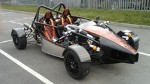
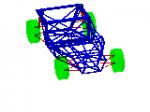
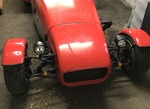
My car is rear engined with inboard suspension, but when giving it plenty of welly, I get lots of squat at the rear.
Is it just stronger springs needed on my coilovers or is there something I have missed?
My coilovers have adjustable bump settings too.
|
|
|
|
|
RazMan
|
| posted on 26/6/06 at 12:47 PM |
|
|
Sounds like the springs are not man enough for the job - can you wind on a bit more preload?
Cheers,
Raz
When thinking outside the box doesn't work any more, it's time to build a new box
|
|
|
nitram38
|
| posted on 26/6/06 at 01:06 PM |
|
|
Razman the springs are already very tight so it looks like new springs.
Cheers Martin
Just re-checked and I think I can wind them up some more. They are Gaz shocks with about 4" of threads. I have them set at 2".
Luckily, I have inboard suspension, so I can re-adjust the links to alter the ride height independant of the springs.
SVA tomorrow, so hopefully I will be able to play around with the springs later in the week.
[Edited on 26/6/2006 by nitram38]
|
|
|
TheGecko
|
| posted on 26/6/06 at 02:00 PM |
|
|
quote:
Originally posted by RazMan
Sounds like the springs are not man enough for the job - can you wind on a bit more preload?
Important point to remember. Winding up the spring platforms might change the ride height but it won't change the spring rate. The only way to
do that is to modify the linkages (for an inboard system) or replace the coils.
D
|
|
|
nitram38
|
| posted on 26/6/06 at 02:19 PM |
|
|
If I compress the springs more then surely the distance they can move overall will be less?
I am trying to reduce too much squat. The ride height can be returned to normal by adjusting the control links.
Roll in corners is ok so I do not want to raise the spring rates if I can help it.
[Edited on 26/6/2006 by nitram38]
|
|
|
C10CoryM
|
| posted on 26/6/06 at 02:59 PM |
|
|
The main flaw with IRS is lack of anti squat. About all you can do is change the angle of the rear control arms. In side view, raise the front of
the control arms. This will only gain you around 20% antisquat at best though.
Only other option really isn't an option. You can make the differential live and run a torque arm. Probably not viable on your chassis.
"Our watchword evermore shall be: The Maple Leaf Forever!"
|
|
|
donut
|
| posted on 26/6/06 at 03:27 PM |
|
|
GOOD LUCK TOMORROW!!
Andy
When I die, I want to go peacefully like my Grandfather did, in his sleep -- not screaming, like the passengers in his car.
http://www.flickr.com/photos/andywest1/
|
|
|
indykid
|
| posted on 26/6/06 at 03:28 PM |
|
|
quote:
Originally posted by nitram38
If I compress the springs more then surely the distance they can move overall will be less?
[Edited on 26/6/2006 by nitram38]
but that means it will be limited by bottoming out the shocks, where spring rate becomes infinite.
if for instance the springs are 200lb/in, it takes 200lb to compress them an inch. if they're uncompressed, the first inch takes 200lb. if
they're compressed 3", the next inch still takes 200lb.
winding them up will only make a difference if they're progressively wound so have variable spring rates on compression, but if the coils are
evenly spaced, they're linear rate and are only adjustable for ride height
hth
tom
|
|
|
britishtrident
|
| posted on 26/6/06 at 03:41 PM |
|
|
A point often missed is that with inboard shocks the wheel rate relates to spring rate as the square of the leverage ratio ie if the the leverage
ratio is 2 units if wheel movement to 1 units of spring movement the springs need to be 4 times stiffer to give the equivalent wheel rate.
|
|
|
Syd Bridge
|
| posted on 26/6/06 at 03:47 PM |
|
|
Oh dear dear. Antisquat geometry. LMAO. 
Weight transfer. That's the cause, however you look at it.
Just a thought, but have you checked the corner weights on a proper set of scales?
Then you need to calculate spring poundages based on wheel frequency chosen. With that little and very light car, you need to put a weight
approximating your own in the seat when doing all of this.
Just a thought.
Cheers,
Syd.
Edit: Talk to Nat, NS Dev, his special wouldn't be too far astray of that thing of ypours for corner weights.
[Edited on 26/6/06 by Syd Bridge]
|
|
|
C10CoryM
|
| posted on 26/6/06 at 04:16 PM |
|
|
quote:
Originally posted by Syd Bridge
Oh dear dear. Antisquat geometry. LMAO.
Weight transfer. That's the cause, however you look at it.
Not sure what you're after there.
Are you saying you do not like anti-squat? Yes weight transfer is what causes squat. The whole point of anti-squat is using the engines power to
reduce, or completely negate the squat caused by the weight transfer. As long as you can do that w/o causing a jacking effect in the corners you
have a major advantage. I will take more traction out of the corners and while launching any day.
Taking springs that work well while driving out and sticking stiffer ones in JUST to reduce the squat is a compromise. It may be acceptable in
this case (yes, Ive done it before with good results) but it will reduce the traction on bumps. If you can add antisquat, do it. Cheers.
Oh ya, good luck at SVA
"Our watchword evermore shall be: The Maple Leaf Forever!"
|
|
|
nitram38
|
| posted on 26/6/06 at 04:49 PM |
|
|
Thanks for all the replies Guys
I am trying to make sure that the rear end does not squat down as much when I give it some stick!!!!!!!!
Spoke to a mate who designs/builds diablo replicas and he advised me to wind the springs in as far as they go. Drive the car and then back off the
springs when I find the best setting.
Other than that, I will have to buy stronger springs.
Donut thanks for the Good Luck for tomorrow.
Expect a Full report, however embarassing it may be!
|
|
|
Deckman001
|
| posted on 27/6/06 at 04:33 PM |
|
|
GOOD LUCK
Jason
|
|
|