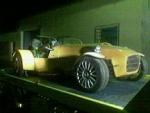
oddsaabs
|
| posted on 30/10/06 at 11:21 PM |

|
|
torque computation
I'm new to this site and look forward to sharing what knowledge I have about building cars with the group. I've been involved with
vintage sports car restoration for some years now. Recently I agreed to help out one of my customers with a bike engine conversion project.
We're dropping a Kawasaki ZX14 motor into the middle of a vintage Saab 96.
I know, the first time I heard about the project I laughed as well. But it's growing on me (like fungus) and I'm getting quite excited
about the prospects for this car both on the street and the track.
Anyway, here's my problem. I'm having a hell of a time converting torque numbers from the engine data to the gear driven diff in order to
spec an appropriate differential. I’d hate to build a rear end only to have it mash up after a few runs because it wasn’t strong enough.
If the motor is listed as producing a maximum of 154 N-m torque, how much torque is produced the chainring bolted to the diff. The drive sprocket is
17 tooth and the chainring is currently speced as 54 tooth. I’ll be the first to admit I’m no engineer, and this type of pure number crunching makes
my head swim. Anybody have any good strategies to determine this number? Do the 6 speed gearbox ratios also come into play in this calculation as
well?
Thanks for all your help and I look forward to helping out the group when the topics fall more in my area of experience.
J
|
|
|
|
|
hillbillyracer
|
| posted on 30/10/06 at 11:43 PM |
|
|
I'm no physics guru but as I understand it the sprockets will see the same strain no matter the mass of the vehicle they are propelling. Less
mass means you go faster, more mass & you go slower but the drivetrain sees the same force in both cases.
If they are strong enough on the bike they should be ok in your car.
Same goes for the diff & driveshafts you use, if they could handle a car engine of similar power & torque they will cope with this.
|
|
|
craig1410
|
| posted on 31/10/06 at 01:18 AM |
|
|
Okay, here's my thoughts on the subject:
154NM of torque at the drive sprocket will give 489NM at the back axle (ie. 154*54/17) due to the 54:17 ratio between drive sprocket and chainring.
But if you have a gearbox between engine crankshaft and the drive sprocket (which I expect you will have) then you will indeed need to take account of
gear ratio as well to calculate maximum 1st gear torque. I don't know much about bikes but car gearboxes are commonly 1:1 in 4th gear and 1st
gear is often between 3:1 and 4:1 if memory serves so 154NM of engine torque could translate into 3 or 4 times that at the drive sprocket which in
turn would translate into 54/17 times that at the chainring. This could be getting on for 2000NM at peak torque. (154*4*54/17 = 1957NM)
Having said all that, for the purposes of rear axle/suspension strength I would tend to look at it differently. With road tyres and without any
substantial downforce (like F1 cars have) you are unlikely to be able to accelerate in any direction at more than 1G (ie. 1 x force of gravity =
10meters/sec/sec) before the tyres will let go. To put this in perspective, if you could maintain 1G acceleration then you would hit 60MPH (ie. ~26.8
meters/sec) in about 2.7 seconds from a standing start.
So, if you have a vehicle weighing 1000Kg then it will take roughly 10000 (F=ma) Newtons of force to accelerate it at 1G. If you then estimate the
tyre radius to be, say 300mm (or 0.3m) then you can work out the useable rear axle torque to be 3000NM (T=Force x Radius) -> 10000 x 0.3 =
3000NM.
So I would say that a 1000Kg vehicle could probably handle 1957NM of axle torque quite happily and would be pretty quick. Ideally keep the weight down
a bit from that and it would be even quicker. Once you get below about 650Kg then you will have more peak torque than you are ever going to be able to
use.
Well, I hope I got my sums right and I'm sure someone will correct me if not... 
Cheers,
Craig.
[Edited on 31/10/2006 by craig1410]
|
|
|
chockymonster
|
| posted on 31/10/06 at 02:05 AM |
|
|
Are you planning on removing much from the car to reduce weight?
PLEASE NOTE - Responses on Forum Threads may contain Sarcasm and may not be suitable for the hard of Thinking.
|
|
|
oddsaabs
|
| posted on 31/10/06 at 04:18 AM |
|
|
Craig, Thanks! That is exactly the type of tutorial I needed. My hunch was the math was fairly straight forward and you confirmed my suspicions. My
tendency is to make things more complicated than they need to be. You should have seen the mess I made on my notepad trying to take into account the
gearbox. I was way over engineering it.
The 1st gear ratio on the Kawasaki gearbox is 2.625 (42/16) and the car should weigh in around 1600lbs (726kg), so I don’t think I’ll have any trouble
with a diff rated at 5,200 Nm of sprocket torque.
Chocky, The stock Saab 96 with a V4 motor rolls in at about 1800lbs. The weight of this car has already been reduced a bit via lighter panels,
wheels, interior parts and bumpers. By the time we replace the chunky V4 cast iron block and transaxle with the Kawi motor and chaindrive diff, I
figure we should be under 1600lbs. That’s leaving a little room to keep the big sound system as we’ll need it to hear anything over the whine of 200
horses at 1100 rpm. ' '
I posted a few pics of the beast in my archive.
Thanks again guys. A real help.
J
|
|
|
craig1410
|
| posted on 31/10/06 at 08:37 AM |
|
|
You're welcome!
Can I just confirm - is your diff just a 1:1 diff without any further gearing?
Yes keep us updated on progress, it sounds like an interesting project.
Cheers,
Craig.
Btw, I calculate your axle torque to be peaking at 1284NM with the figures you state above.
[Edited on 31/10/2006 by craig1410]
|
|
|
tks
|
| posted on 31/10/06 at 08:46 AM |
|
|
1100 or 11000?? rpm??
The sound of the engine is allotnicer then many tracks out of the sound system...
Tks
The above comments are always meant to be from the above persons perspective.
|
|
|
Bob C
|
| posted on 31/10/06 at 12:07 PM |
|
|
Just thought I'd add the old formula connecting torque and power. Power is proportional to torque x revs. On a "power graph" in
imperial units, the power curve ALWAYS crosses the torque curve at 5250rpm (ft lbs and bhp are equal at 5250rpm)
power = torque * revs / 5250
|
|
|